
Court Records After a St. John the Baptist Parish Arrest
After an arrest in St. John the Baptist Parish, the custody record and the court record serve different purposes. Sheriff Mike Tregre's office operates the local jail system and publishes custody information through the official inmate roster at stjohn-so-la.zuercherportal.com/#/inmates. That roster may show a mugshot, arrest date, held-for agency, release date, bond text, and hold reasons. The court records after the jail arrest are handled through the 40th Judicial District Court, the St. John the Baptist Parish Clerk of Court, and the District Attorney's Office once formal charges or court events exist.
The 40th Judicial District Court is the parish court of general jurisdiction for criminal felonies, misdemeanors, traffic, juvenile, family, probate, and civil matters. Its court site at 40thjdc.org explains that jury trials, bench trials, felony motions, Division B drug pleas, and Drug Court are centered in Edgard. The court page also notes that court is not being held in LaPlace at the Arcuri Center due to Hurricane Ida destruction, which is a practical reason to verify the active courtroom before appearing.
For the custody side of the same event, use jail inmate records. For booking photos and the public roster photo column, use jail mugshots. The court record itself is the prosecution file: charging documents, docket settings, bond orders, judge activity, dismissals, pleas, sentences, and expungement-related entries where available.
How to Find Court Records After an Arrest
Start with the arrest information, then move to the official court and Clerk channels. The St. John the Baptist Parish Clerk of Court site at sjbparishclerk.gov is the main local channel for court records. The Clerk contact page at sjbparishclerk.gov/contact lists Edgard and LaPlace offices, phone numbers, fax numbers, hours, and online-records support. Clerk Connect at clerkconnect.com is a subscription inquiry portal that may include criminal cases for participating Louisiana clerks, while eClerks LA at evaultla.com/home is a statewide records portal that may require a supported browser.
- Use the jail roster or arrest report to collect the person's name, arrest date, held-for agency, charge wording, warrant wording, and any bond or judge text.
- Contact or search the St. John the Baptist Parish Clerk of Court with the defendant name, case number if known, arrest date, charge, division, or date of birth if the Clerk requests it.
- Check whether the District Attorney has filed a bill of information, indictment, complaint, or other charging document that opens or updates the criminal case.
- Read each charge separately because one arrest can produce multiple counts, different bond conditions, amended charges, and separate status entries.
The Clerk's Edgard phone is (985) 497-3331, the LaPlace office phone is (985) 652-8041, the jury line is (985) 267-1599, and the criminal fax is 985-497-6941. Clerk hours in the research are Monday through Friday, 8:30 a.m. to 4:30 p.m., with the Eastbank office closing 12 to 1 daily. The Westbank courthouse is listed at 2393 Highway 18, Edgard, LA 70049. The Clerk contact page lists the New Government Complex at 1811 W. Airline Hwy., LaPlace, LA 70068, for the Eastbank office.
The Clerk contact page is a subject-matched source for court-record access details: view the St. John the Baptist Parish Clerk contact source.
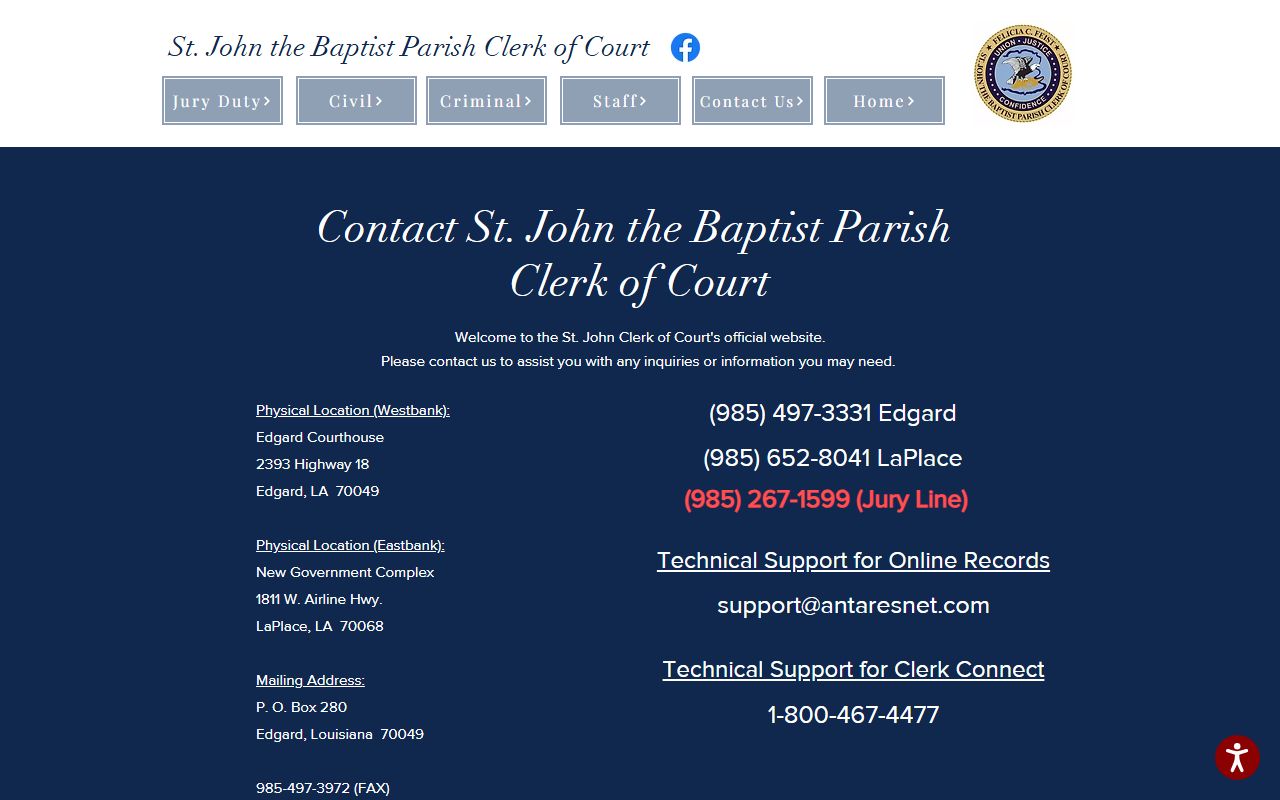
Those office details matter because a court search often needs a case number, division, or criminal-record request path that the jail roster does not provide.
How Charges Get Filed After an Arrest: Complaint, Information, and Indictment
A jail arrest starts with booking and custody. Louisiana Code of Criminal Procedure Article 228 requires a person who has been arrested to be brought to a jail or police station and booked, with entries such as name, address, property taken, booking date and time, and a booking information summary. The court record begins when the prosecutor or court receives a formal charging instrument. In St. John the Baptist Parish, the prosecutor is the District Attorney for the 40th Judicial District, Bridget A. Dinvaut.
| Document | Usually Filed By | Common Use | What to Check |
|---|---|---|---|
| Complaint | Officer, court, or prosecutor depending on procedure | Initial accusation or lower-level criminal matter | Whether the complaint matches the jail hold reason or has been replaced by another filing |
| Bill of Information | District Attorney | Many Louisiana criminal prosecutions, including felony matters filed by the DA | Statute number, count number, filing date, and any amended charge language |
| Indictment | Grand jury | Serious felony matters requiring or using grand-jury action | Indicted counts, arraignment date, bond changes, and assigned division |
| Warrant or Attachment | Court or judge | Failure to appear, contempt, probation matters, or fugitive issues | Issuing court, warrant number, bond amount, and whether another agency must clear the hold |
The DA website at stjohnda.com lists divisions for felonies, misdemeanors, juvenile justice, child support, victim services, worthless checks, civil work, diversion programs, Drug Court, traffic court, expungement information, case search, and weekly docketing and sentencing. The main DA office is listed at 1342 LA Hwy 44, River Road, Reserve, LA 70084, phone (985) 652-9757, with hours of 8:00 a.m. to 4:00 p.m. The courthouse/parish seat DA contact shown in the research is 2393 LA Hwy 18, Edgard, LA 70049, phone (985) 497-8270.
Charge Status in Court Records After a Jail Arrest
Booking charges are not final court outcomes. The roster may show statute numbers, charge text, warrants, probation holds, bond type and amount, counts, and a judge name. Sample local records included felony charge wording, sex-offender-registration allegations, rebook entries for Louisiana Department of Corrections, fugitive warrants, bench warrants, judicial warrants, and probation holds. Those entries are useful starting points, but the court record controls the prosecution status once the case is filed.
| Status | What It Means | Practical Effect |
|---|---|---|
| Pending | The charge is open and has not reached a final disposition. | Check the next court date, bond order, assigned division, and whether the defendant remains in custody. |
| Amended or reduced | The filed charge changed from the original arrest wording or from an earlier court filing. | The court charge may be less serious, more specific, or different from the jail roster entry. |
| Dismissed | The court ended that charge without a conviction on that count. | Other counts, warrants, holds, or new filings may still remain active. |
| Nolle prosequi | The prosecutor declined to proceed on the charge at that stage. | It is not the same as an acquittal, and legal effect can depend on the case record. |
| Plea or conviction | The defendant entered a plea or was found guilty by the court or jury. | Sentencing, fines, probation, custody credit, or DPS&C transfer may follow. |
Bond, Release, and Court Orders After an Arrest
Bond information can appear in both jail and court sources. The St. John the Baptist Parish roster examples inspected in the research included labels such as "Bond - No 10%, $75000.00," "Bond - No Bond," and "Bond - Unspecified Bond, $10000.00." Some entries named judges, including Judge Nighana Lewis and Judge Sterling Snowdy. A roster bond label is a clue, not a complete release instruction. Bond is typically set by a judge, magistrate, or court order, and holds for probation, parole, another parish, DOC, federal authorities, or ICE can prevent release even when one charge has an amount listed.
| Bond Type | How It Works | Local Caution |
|---|---|---|
| Cash bond | The court requires cash payment under the order. | Verify accepted payment method and current amount with the jail or Clerk before acting. |
| Surety bond | A licensed commercial bondsman posts under Louisiana bonding rules. | Commercial bail bonding exists in Louisiana, but a hold may still block release. |
| Property bond | Property may be used if allowed by court procedure. | Do not assume availability unless the court or Clerk confirms it. |
| PR or own recognizance | The court allows release on written promise and conditions rather than upfront payment. | Conditions may include court dates, supervision, no-contact orders, or other restrictions. |
| No-bond hold | No ordinary payment option is available for that hold or case stage. | Call the jail at (985) 359-8716 or the Sheriff's Office at (985) 652-9513 to confirm the reason. |
Warrants That Become Jail Arrest and Court Records
Warrants often connect older court records to a new jail arrest. The sheriff's Most Wanted page at stjohnsheriff.org/crime-arrests/most-wanted/ says fugitives listed there are actively sought by the St. John the Baptist Parish Sheriff's Office. It gives a TIPS line at 985-359-TIPS, the Criminal Investigations Division at 985-359-8769, and CrimeStoppers at 504-822-1111. The research also notes that the St John Parish Sheriff Office app advertises warrants as a feature.
A warrant arrest can appear on the roster as a bench warrant, judicial warrant, attachment warrant, fugitive warrant, probation hold, or hold for another agency. The court record may sit with the issuing court rather than the court where the person was physically booked. For a 40th JDC bench warrant, check the Clerk and court channels. For another parish, federal, or agency warrant, the St. John jail may only show the custody hold while the issuing authority controls the underlying case.
Charges vs. Convictions
An arrest charge is an accusation or custody basis. A conviction is a formal outcome after a plea, trial verdict, or other adjudication. The sheriff roster notice summarized in the research says the information can change quickly and may not reflect true charges, status, or other case information, and that nothing implies guilt or wrongdoing. That warning is especially important when comparing court records after an arrest with the original booking entry.
| Charge | Conviction | |
|---|---|---|
| Stage | Allegation filed or listed after arrest | Resolved finding or plea accepted by the court |
| Where it appears | Jail roster, arrest report, charging document, or docket | Disposition, minute entry, plea record, judgment, or sentence |
| Can it change? | Yes, it may be amended, reduced, dismissed, or replaced. | Changes require later court action, appeal, post-conviction relief, or expungement-related orders. |
| How to verify | Compare roster text with the Clerk, 40th JDC, and DA filing. | Confirm final disposition through the Clerk or court record. |
Sealed vs. Expunged Arrest and Court Records
Louisiana public-records access is broad, but criminal records have important exceptions. Louisiana R.S. 44:1 defines public records, R.S. 44:31 gives adults a right to inspect and copy public records unless another law says otherwise, R.S. 44:32 governs examination, copying, fees, and custodian duties, and R.S. 44:3 creates criminal-record exceptions. The sheriff's public-records page says criminal offense records are generally privileged until adjudicated and lists categories that may remain withheld, including investigative reports, supplemental reports beyond property information, statements, juvenile information, sexual-offense victim-identifying information, undercover information, confidential sources, security procedures, and certain investigative techniques.
| Sealed or Confidential | Expunged | |
|---|---|---|
| Basic idea | The record is not available to ordinary public inspection or is restricted by law or court order. | Qualifying arrest or conviction records are made confidential through Louisiana expungement procedure. |
| Common reason | Juvenile matter, protected victim information, active investigation, or court restriction. | Dismissal, eligible disposition, or other qualifying result under Louisiana Code of Criminal Procedure Article 971 et seq. |
| Public lookup effect | The Clerk, sheriff, or court may withhold or redact the record. | The public may not see the record through ordinary channels after the expungement is processed. |
| Where to ask | Originating agency, Clerk, or court with the case number. | Clerk of Court, court record, and DA expungement information. |
Background Check Considerations
Casual court-record lookup is not the same as a regulated background check. A public roster entry, arrest report, or court docket may be incomplete, delayed, or changed by later case events. A proper employment, housing, credit, insurance, or tenant-screening background check must follow the Fair Credit Reporting Act and other applicable law. Public arrest data should not be treated as proof of guilt or as a final criminal-history report.
Important: St. John the Baptist Parish Inmate Population is not a consumer reporting agency and cannot be used for FCRA-covered screening decisions.
Restricted Court Records After an Arrest in St. John the Baptist Parish
Some records tied to a jail arrest are public only in part, or not public at all. Written sheriff records requests go to Sheriff Mike Tregre, St. John the Baptist Parish Sheriff's Office, P.O. Box 1600, LaPlace, LA 70069, or records.request@stjohnsheriff.org. The public-records page at stjohnsheriff.org/about-us/public-records/ also says the Criminal Records Division keeps a records-release ledger with requester details such as name, address, date of birth, driver's license number, file number, item number, report type, and pages released.
That request channel is useful for older booking or offense records, but it does not override the Clerk's control of court records or the statutory exceptions for criminal matters. If a case has moved from jail custody into prosecution, the Clerk, 40th JDC, and DA channels should be checked along with the sheriff record. If the person may have entered Louisiana DPS&C custody after sentencing, use Louisiana VINE at vinelink.vineapps.com/state/LA or the DPS&C locator phone line identified in the research. If the person is federal or immigration custody, the parish court record may only explain the local charge or hold while BOP or ICE handles custody location.
Public Record Search
Sponsored Results